

Mwalimu National Ranked Kenya's Richest SACCO by Total Assets in 2025
Mwalimu National, Stima and Kenya Police were Kenya's three largest SACCOs by total assets in 2025, according to SASRA.
By saccofiti ResearchUpdated
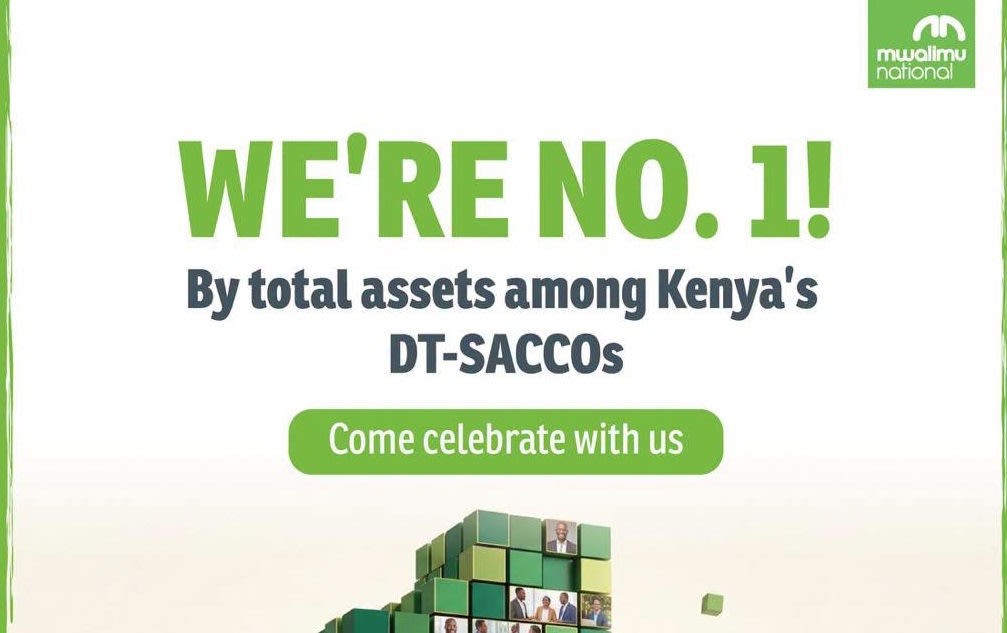
Mwalimu National, Stima and Kenya National Police were Kenya's three largest SACCOs by total assets in 2025, according to the SACCO Societies Regulatory Authority (SASRA).
Mwalimu National led with KES 76.31 billion in assets, followed by Stima with KES 75.27 billion and Kenya National Police with KES 66.40 billion.
The gap between Mwalimu National and Stima narrowed considerably. Mwalimu National was ahead by KES 2.38 billion in 2024, but that difference fell to KES 1.04 billion in 2025.
Tower Sacco completed the top five, with KES 34.56 billion in assets, behind fourth-placed Harambee Sacco, which held KES 41.29 billion.
Kenya's regulated SACCO industry also continued to expand. Total assets reached KES 1.21 trillion in December 2025, up from KES 1.08 trillion a year earlier.
Kenya's 50 Largest SACCOs in 2025
The following ranking is based on total assets reported in SASRA's SACCO Supervision Annual Report, 2025.
It combines deposit-taking (DT) and non-withdrawable deposit-taking (NWDT) SACCOs to provide a single ranking of Kenya's 50 largest regulated SACCOs as of 31 December 2025.
View The Full Ranking: Sacco Rankings
Which SACCOs Recorded the Biggest Asset Growth in 2025?
Defence Sacco recorded the highest percentage growth among the 50 largest SACCOs. Its assets increased by 57.7%, from KES 9.22 billion in 2024 to KES 14.54 billion in 2025.
K-Unity followed with growth of 27.7%, while Transnation recorded a 25.2% increase.
GDC and Tembo also recorded notable growth of 24.9% and 24.5%, respectively.
In absolute terms, however, Stima Sacco recorded the largest increase in assets among the top 50.
Its assets grew by KES 8.76 billion during the year, compared with an increase of KES 7.42 billion at Mwalimu National.
Kenya National Police added KES 6.57 billion, while Tower increased its assets by KES 6.52 billion.
Tower's growth was particularly notable because it increased its assets by 23.3% while maintaining its position among Kenya's five largest SACCOs.
Five SACCOs Crossed the KES 10 Billion Mark
Five SACCOs that began 2025 with assets below KES 10 billion crossed that threshold by the end of the year.
These were Defence, Amica, Unison, Bingwa and Solution.
Defence recorded the largest increase among the five, growing from KES 9.22 billion to KES 14.54 billion.
Amica increased its assets from KES 8.73 billion to KES 10.79 billion, while Unison grew from KES 9.04 billion to KES 10.55 billion.
Bingwa reached KES 10.48 billion, up from KES 8.98 billion, and Solution crossed the threshold with KES 10.03 billion.
By December 2025, 34 SACCOs in the top 50 had assets exceeding KES 10 billion.
Afya Sacco Recorded a Decline in Assets
Afya was the only institution in the combined top 50 whose reported total assets declined between 2024 and 2025.
Its assets fell by KES 840 million, from KES 22.79 billion to KES 21.95 billion, representing a decline of approximately 3.7%.
The Sacco also reported a reduction in its gross loan book, from KES 12.87 billion to KES 10.92 billion.
Its total income decreased from KES 2.62 billion to KES 1.52 billion over the same period.
Despite the decline, Afya remained Kenya's eighth-largest SACCO by total assets in 2025.
A reduction in assets alone does not establish whether a SACCO is experiencing financial difficulties. Its capital position, liquidity and other financial indicators must also be considered.
Kenya's 50 Largest SACCOs Hold Over KES 875 Billion in Assets
The 50 SACCOs in this ranking collectively held approximately KES 875.92 billion in assets at the end of 2025.
That represented about 72% of the KES 1.21 trillion held by all 357 regulated SACCOs covered in the report.
The three largest institutions alone—Mwalimu National, Stima and Kenya National Police—held a combined KES 217.98 billion.
SASRA's report also shows that the wider group of 61 large SACCOs held KES 939.69 billion, representing 77.62% of all regulated SACCO assets.
This shows how much of the industry's assets are concentrated in its largest institutions.
Under SASRA's classification, SACCOs with assets exceeding KES 5 billion fall into the large category. Those with assets between KES 1 billion and KES 5 billion are classified as medium-sized, while institutions below KES 1 billion are considered small.
Does a Bigger SACCO Mean a Better SACCO?
A SACCO's total assets show the value of the resources it controls, including its loan portfolio, cash, investments and other assets.
However, having more assets does not automatically mean that a SACCO is more profitable or financially stronger than a smaller institution.
Members should also consider the following financial indicators:
Member deposits: The amount of money members have saved with the SACCO.
Capital adequacy: Whether the SACCO has sufficient capital to absorb potential losses.
Liquidity: Its ability to meet financial obligations, including withdrawals, when they become due.
Non-performing loans: The proportion of loans that are not being repaid as agreed.
Dividends and deposit interest: The returns paid to members on qualifying shares and deposits.
For example, Stima had fewer total assets than Mwalimu National in 2025 but reported a slightly larger gross loan book.
Stima's gross loans stood at KES 57.49 billion, compared with Mwalimu National's KES 56.98 billion.
This illustrates why members should consider several financial indicators rather than relying on total assets alone.
For someone looking to join a SACCO, its financial position should be considered alongside its membership requirements, loan products, charges and historical member returns.
How the 2025 SACCO Rankings Were Compiled
This ranking uses financial figures published in SASRA's SACCO Supervision Annual Report, 2025.
The figures cover the financial year ended 31 December 2025 and are drawn from the audited financial statements included in the regulator's report.
The ranking combines the deposit-taking SACCOs listed in Appendix III with the non-withdrawable deposit-taking SACCOs listed in Appendix IV.
SACCOs are ordered by their reported total assets, from highest to lowest. The growth percentages compare each institution's 2025 assets with its 2024 figures.
The ranking is based on asset size, not profitability, dividends, deposit interest or overall financial strength.
View The Full Ranking: Sacco Rankings